In the yard at home, I planted several individuals of Cosmos bipinnatus. Most of the flowers were pink, white, or pink with a darker gradient around the disk. Among that population of Cosmos bipinnatus in the yard, however, there was one individual that looked different from the others.
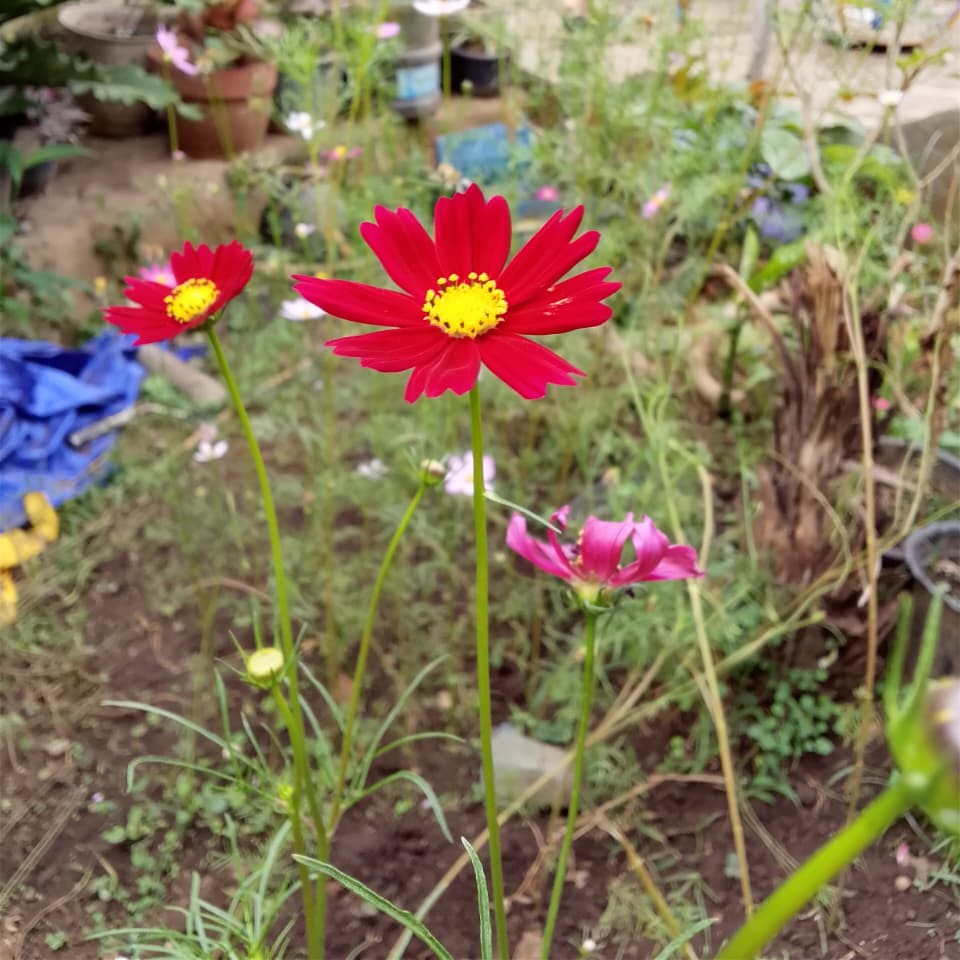
Dark red Cosmos bipinnatus in the yard
Its color was almost like red velvet, with a bright yellow disk at the center, and its position was slightly separated from the other cosmos plants. Visually, this flower immediately caught my attention because it disrupted the pattern that had already formed in my head: cosmos in my yard meant pink and white.
Then one red flower appeared, like a small footnote from genetics.
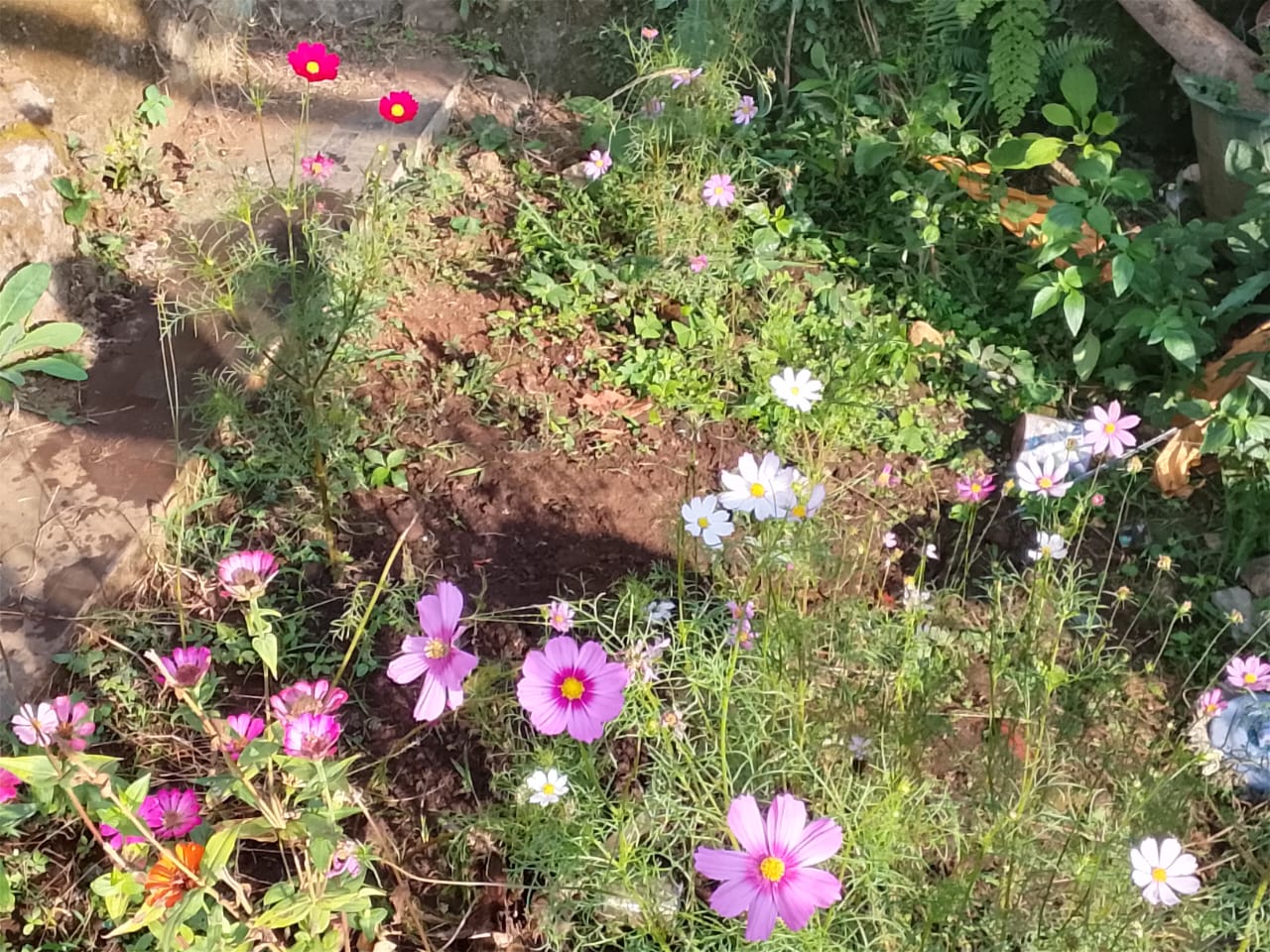
the red one, separated among pink and white flowers
General description
Cosmos bipinnatus Cav. is a member of the family Asteraceae. In horticultural sources, this plant is often known as garden cosmos, Mexican aster, or tall cosmos.12
Its flower is arranged as a typical Asteraceae capitulum: the outer part consists of ray florets that look like “petals”, while the center consists of yellow disc florets. Its leaves are fine, bipinnately divided, and give a light impression, almost like green lace.
As a species commonly grown as an ornamental plant, Cosmos bipinnatus is often found in color variations ranging from white, pink, pale purple, and red to maroon. Because of that, the red flower that appeared in my yard is most likely not a different species. It is more likely one of the color variations within the same species, especially if the seeds came from a mixed variety packet.
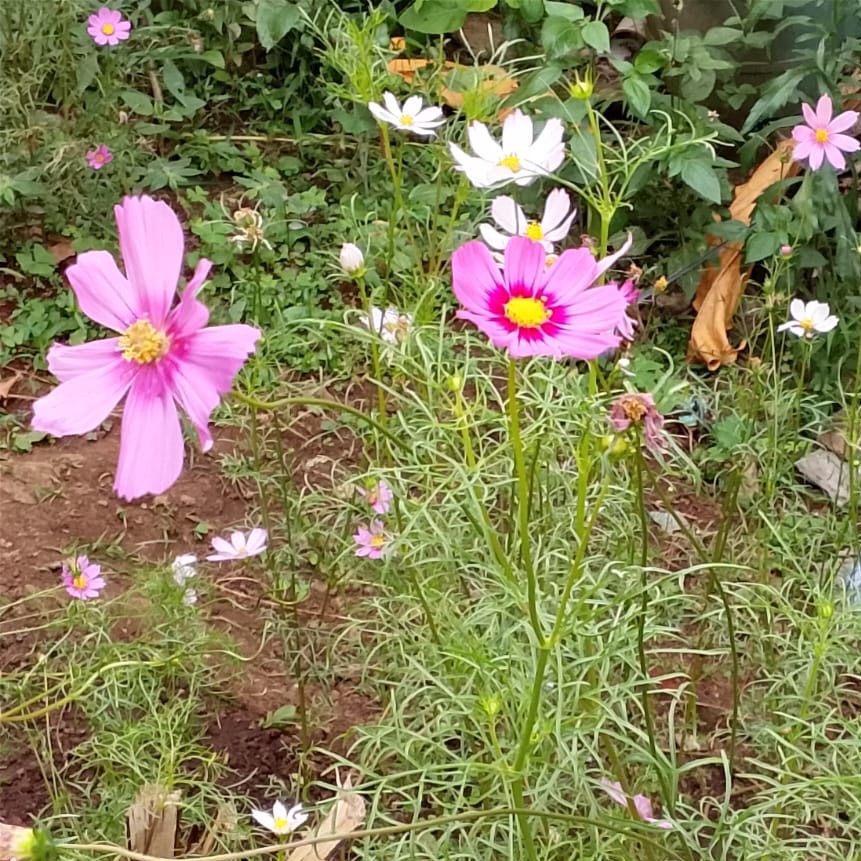
A population of pink and white Cosmos bipinnatus
Identification & Field Information
CbCosmos bipinnatus Cav.
Family: Asteraceae
Location Home yard
🌸Color dominance
The population is dominated by pink and white color variations.
🔴An individual that differs from the population tendency
One flower is dark red with a yellow center or disc florets.
Position Slightly separated from the main group
^_^Evidence gap
This observation is enough to raise a question, but not enough to establish a cause.
The separation of its growing position is not enough to conclude anything. The question is:
Did this red color appear mainly because of genetic factors, microhabitat conditions, or a combination of both?
Temporary hypothesis
For now, the hypothesis is genetic variation. Each seed carries a different combination of genes. In flowering plants, petal color can be influenced by pigments such as anthocyanins, as well as by gene expression that regulates the production and distribution of those pigments.
The environment may also influence the final appearance. In Cosmos bipinnatus, the color of the ligules or ray florets has been associated with abiotic factors such as soil pH. However, the same source also states that genetic factors probably make a strong contribution to ligule color, while soil pH may play a smaller role.3
So, in this yard case, I cannot say that the red flower appeared because of the environment. What can be said more carefully is:
One dark red individual appeared among a population of Cosmos bipinnatus dominated by pink and white flowers. This difference is likely a phenotypic variation within the same species, with genetic factors as a reasonable initial suspicion.
That sentence is not dramatic, but science often prefers flat shoes over high heels, just to reduce the chance of falling.
Closing note
This red flower gives a small disturbance to expectation.
Based on my experience, small disturbances often become the entrance to clearer questions. At first, it is only “why is this one different?”, but slowly it turns into a neater question: what information is still incomplete, what factors might be involved, and how can it be observed again?
Sometimes science does not begin from a microscope or a laboratory, but from one flower in the yard that seems not to follow the script of the majority color.